Could your dog be a banned type without you knowing? That question is why we made this infographic. More than 57,000 XL Bullies were registered for exemption in England and Wales, far more than the government expected, and many owners only found out what “banned type” really means when the deadline hit.
The list of banned dog breeds in the UK is short: five types. The rules around them are not. The law judges a dog on its looks rather than its pedigree, it differs between England and Wales, Scotland and Northern Ireland, and two of the rules change again in 2026. So we put the whole thing on one page.
What dogs are banned in the UK?
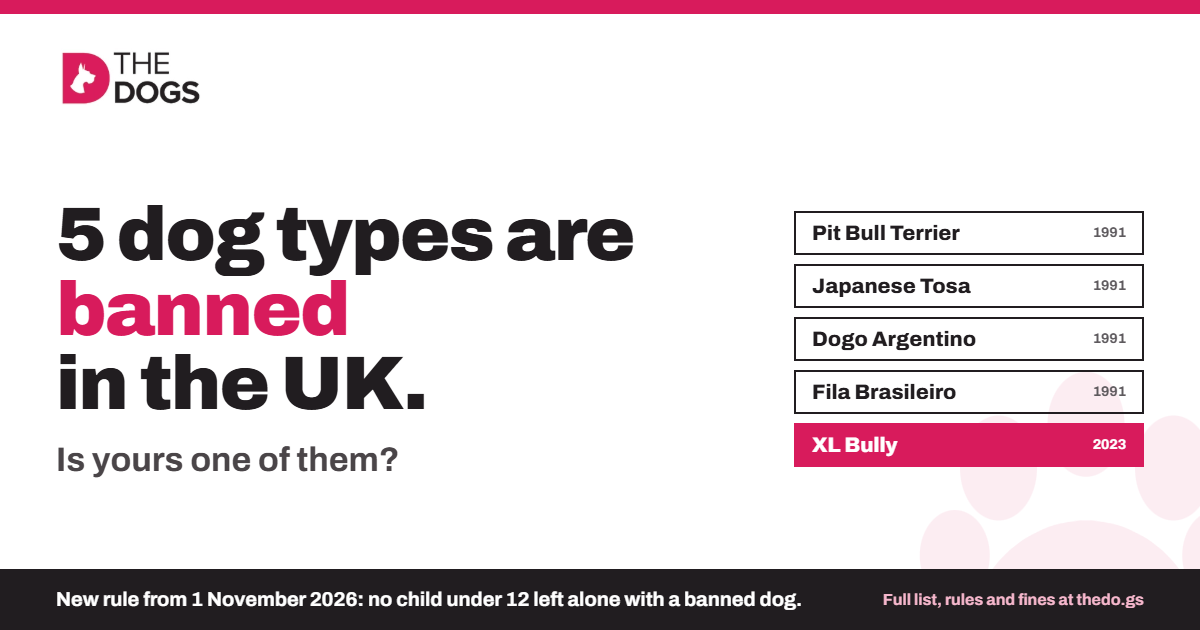
Five types of dog are banned in the UK under section 1 of the Dangerous Dogs Act 1991:
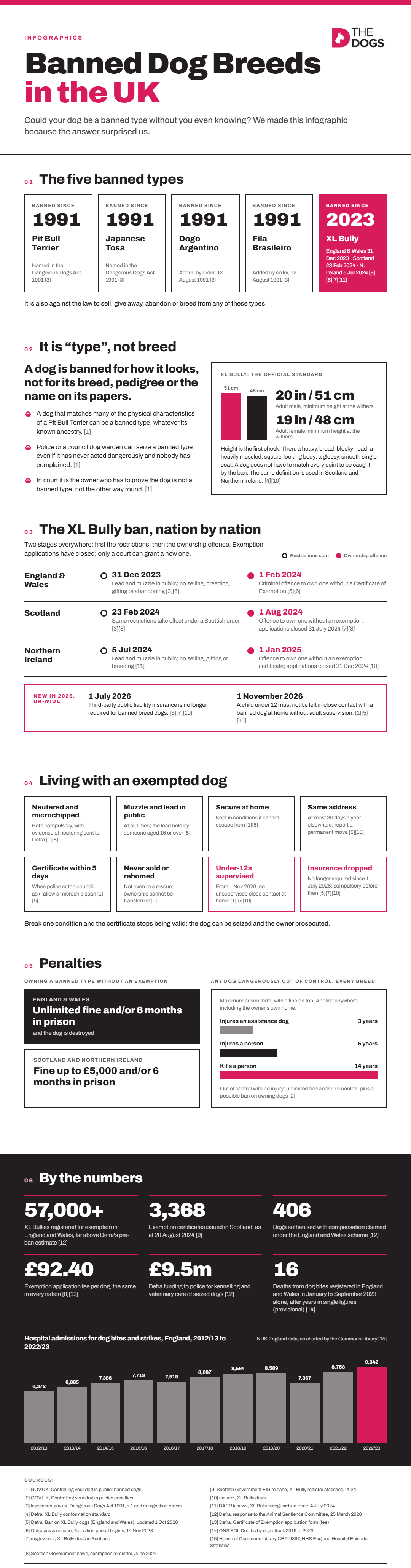
- Pit Bull Terrier, banned since 1991
- Japanese Tosa, banned since 1991
- Dogo Argentino, banned since 1991
- Fila Brasileiro, banned since 1991
- XL Bully, banned in England and Wales from 31 December 2023, Scotland from 23 February 2024 and Northern Ireland from 5 July 2024
It is also illegal to sell, give away, abandon or breed from any of them. Owning one without a Certificate of Exemption is a criminal offence, and the police can seize a banned type even if it has never acted dangerously and nobody has complained.
That is the whole list. No Rottweilers, no Dobermanns, no Staffies. If you are wondering why the ban targets only five types, the answer is in how the law defines a banned dog, and it surprises most people.
How police decide if your dog is a banned type (and why your Staffy isn’t)
Here is the part that catches owners out: the Dangerous Dogs Act 1991 bans types, not breeds. Whether your dog is banned depends on what it looks like, not its pedigree, its DNA test or the name on its papers. A crossbreed that matches enough of the physical characteristics of a Pit Bull Terrier can be a banned type with no Pit Bull anywhere in its known family tree.
It gets tougher. If the case reaches court, the burden of proof flips: it is the owner who has to prove the dog is not a banned type, not the police who have to prove it is.
What is an XL Bully, legally?
For the XL Bully, Defra published a conformation standard that police Dog Legislation Officers and courts work from. Height is the first check:
- Adult male: from 20 in (51 cm) at the withers
- Adult female: from 19 in (48 cm) at the withers
After height, officers look for a heavy, broad, blocky head, a heavily muscled, square-looking body and a glossy, smooth single coat. A dog does not need to match every point to be caught, and Scotland and Northern Ireland use the same definition as England and Wales.
So is my Staffy banned?
No. The Staffordshire Bull Terrier is not on the list, and neither is any other Kennel Club breed. A dog is only caught if it matches the description of one of the five banned types. The confusion comes from the “type” rule above: a large bull-breed cross can be assessed against the XL Bully standard, so if your dog is a big mixed-breed bully, it is worth knowing the measurements.
The XL Bully ban: dates for every UK nation
The XL Bully ban did not arrive on one day. Each nation brought it in over two stages: first the restrictions (muzzle and lead in public, no selling, breeding, gifting or abandoning), then the ownership offence. Exemption applications have now closed everywhere, so the only route to a new certificate is a court order.
| Date | Nation | What changed |
|---|---|---|
| 31 December 2023 | England and Wales | Restrictions begin |
| 1 February 2024 | England and Wales | Offence to own an XL Bully without a Certificate of Exemption |
| 23 February 2024 | Scotland | Restrictions begin |
| 5 July 2024 | Northern Ireland | Restrictions begin |
| 1 August 2024 | Scotland | Offence to own one without an exemption; applications closed 31 July 2024 |
| 1 January 2025 | Northern Ireland | Offence to own one without an exemption certificate; applications closed 31 December 2024 |
XL Bully in Scotland
Scotland copied the England and Wales definition and fee (£92.40 per dog) but set its own penalty: a fine of up to £5,000 and/or 6 months in prison for keeping an unexempted dog. By 20 August 2024, 3,368 exemption certificates had been issued.
XL Bully in Northern Ireland
Northern Ireland was last, with the ownership offence starting on 1 January 2025. Exemptions there are handled by local councils rather than Defra, and the dog also needs a standard council dog licence.
Two rules change in 2026, and one of them is about your kids
If you own an exempted dog, 2026 changes your paperwork and your home life.
1 July 2026: XL Bully insurance is no longer required
Third-party public liability insurance was a condition of every Certificate of Exemption from day one. From 1 July 2026 it no longer is, in England and Wales, Scotland and Northern Ireland. Existing policies can simply run to expiry. Keeping cover is still sensible, because an owner remains liable for what their dog does, but the law no longer demands it.
1 November 2026: children under 12 must never be left alone with a banned dog
From 1 November 2026, a child under 12 must not be left in close contact with a banned dog in a private place, meaning your home or garden, without adult supervision. It becomes a condition of the exemption, so breaking it means the dog can be seized and the owner prosecuted.
This is the rule most owners have not heard about, and it lands in a few weeks. If you know someone with an exempted dog and young children, this is the paragraph to send them.
Living with an exempted dog: the rules, the fines and the prison terms
A Certificate of Exemption lets you keep a banned dog for its lifetime, as long as it never behaves dangerously and you keep to every condition. Miss one and the certificate stops being valid.
- Neutered and microchipped, with proof of neutering sent to Defra
- Muzzled and on a lead at all times in public, the lead held by someone aged 16 or over
- Kept in secure conditions it cannot escape from
- Kept at the address on the certificate, with at most 30 days a year elsewhere
- Certificate shown to police or the council within 5 days of a request, with the dog available for a microchip scan
- Never sold, given away or rehomed, even to a rescue
- From 1 November 2026, never left in close contact with a child under 12 without an adult present
- Insurance no longer required from 1 July 2026
What you face if you get it wrong
| Offence | Maximum penalty |
|---|---|
| Owning a banned type without an exemption, England and Wales | Unlimited fine and/or 6 months in prison; the dog is destroyed |
| Owning a banned type without an exemption, Scotland and Northern Ireland | Fine up to £5,000 and/or 6 months in prison |
| Any dog dangerously out of control (every breed) | Unlimited fine and/or 6 months; possible ban on owning dogs |
| Your dog injures a person | Up to 5 years in prison |
| Your dog injures an assistance dog | Up to 3 years in prison |
| Your dog kills a person | Up to 14 years in prison |
The bottom three rows apply to every dog in the country, banned type or not, and they apply in your own home as well as in public.
The numbers behind the ban
Nobody had an accurate count of XL Bullies before the ban. Defra’s own estimate turned out to be far too low: more than 57,000 were registered for exemption in England and Wales alone.
- 57,000+ XL Bullies registered for exemption in England and Wales
- 3,368 exemption certificates issued in Scotland by 20 August 2024
- 406 dogs euthanised with compensation claimed under the England and Wales scheme, which closed on 15 March 2024
- £92.40 paid per dog to apply for exemption
- £9.5 million given to police forces to kennel and care for seized dogs
- 16 deaths from dog bites registered in England and Wales in the first nine months of 2023 alone, after years in single figures
- 6,372 to 9,342: the rise in hospital admissions for dog bites and strikes in England between 2012/13 and 2022/23, a 47% increase in a decade
One figure does not exist: the ONS does not record the breed of dog involved in a death, so nobody can say officially how many of those deaths involved an XL Bully. Keep that in mind the next time a headline claims to.
Banned dog breeds in the UK: your questions answered
Are pitbulls banned in the UK?
Yes. The Pit Bull Terrier has been banned since 1991 and is named in the Dangerous Dogs Act itself. Because the law works on type, a dog that looks substantially like a Pit Bull can be seized even if it was sold to you as a Staffy cross.
Are Staffies banned in the UK?
No. The Staffordshire Bull Terrier is a Kennel Club breed and is not one of the five banned types.
Can I still apply for an XL Bully exemption?
No. Applications closed on 31 January 2024 in England and Wales, 31 July 2024 in Scotland and 31 December 2024 in Northern Ireland. A new exemption can now only come through a court, usually after a Contingent Destruction Order where a judge decides the dog is not a danger to the public.
Do I still need XL Bully insurance?
Not by law. Third-party liability insurance stopped being a condition of exemption on 1 July 2026 across the UK. You remain liable for your dog, so many owners keep a policy anyway.
Can my child be around my exempted dog?
Yes, with an adult present. From 1 November 2026 a child under 12 must not be left in close contact with a banned dog in a private place without adult supervision.
Is the XL Bully banned in Scotland and Northern Ireland?
Yes. Scotland’s ownership offence began on 1 August 2024 and Northern Ireland’s on 1 January 2025, using the same definition as England and Wales.
What happens if the police seize my dog?
The dog is kennelled while it is assessed against the type standard. If it is found to be a banned type and you have no valid certificate, the court can order it destroyed, or issue a Contingent Destruction Order that lets you apply for exemption if the dog is not judged a danger.
Share the infographic
Found this useful? Feel free to share this infographic on social media, with a link back to this page as the source. Vets, rescues, trainers and dog walkers are welcome to print it for the waiting room.